

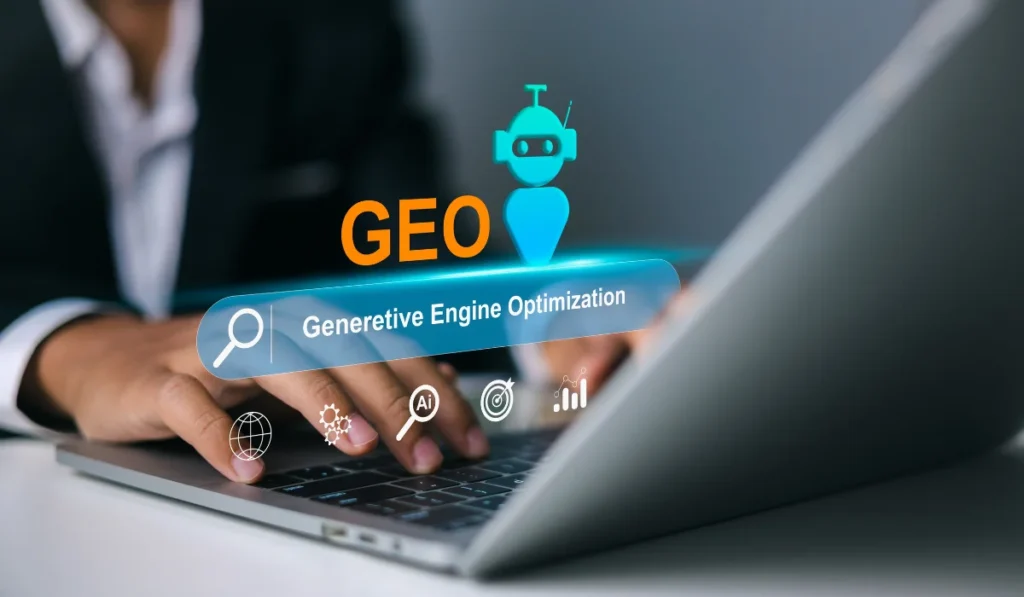
Generative engine optimization (GEO) is the practice of structuring your content so that AI-powered search systems, like Google’s AI Overviews, ChatGPT, and Perplexity, pull from your website when generating answers. Unlike traditional SEO, which focuses on ranking in a list of blue links, GEO focuses on getting your content cited, quoted, or referenced inside the AI-generated response itself.
Key Takeaways
- GEO targets AI-generated answers, not just traditional search rankings. Being listed in a results page is no longer enough if the AI answers the question before the user scrolls.
- Authoritative, well-structured content with clear answers is what AI systems prioritize when pulling sources.
- Your existing SEO investment is not wasted. GEO builds on it, but adds new layers around clarity, credibility, and citation-readiness.
- Brand visibility in AI responses can drive awareness even when users never click through to your site.
- Monitoring which AI platforms are surfacing your brand is now a necessary part of any digital marketing strategy.
- The shift toward AI-generated answers is accelerating, and businesses that adapt early will hold a significant competitive advantage.
Why Traditional SEO Is No Longer Enough
For the past two decades, SEO was built around one core idea: show up near the top of a list of search results. You optimized your title tags, built backlinks, and earned a top-three position. Users would scan the results, click a link, and land on your page. Traffic flowed predictably.
That model is breaking down fast.
Google’s AI Overviews, launched broadly in 2024, now appear at the very top of the search results page for a wide range of queries. Instead of sending users to your site, the AI synthesizes an answer directly on the page using information pulled from multiple sources. If your brand is not one of those sources, you are invisible, even if you rank in position one organically.
Understanding why is google ai overview stealing clicks is the first step to realizing why GEO is not optional anymore. Organic click-through rates are falling in categories where AI Overviews dominate, including health, personal finance, how-to queries, and product comparisons. The user got their answer before they ever clicked. That is a structural shift in how search works, not a temporary trend.
This is the gap that generative engine optimization (GEO) is designed to fill. Instead of optimizing for a ranking position, you are optimizing to be the source the AI trusts, cites, and quotes.
How Generative Engine Optimization (GEO) Actually Works
AI-powered search engines like Google’s Gemini, Perplexity, and ChatGPT with Browse do not work the way a traditional crawl-and-rank system does. They are language models that read enormous amounts of text, identify which sources seem authoritative and accurate, and then synthesize a coherent answer. When you ask one of these systems a question, it is not pulling up a ranked list. It is generating a response, then attributing parts of that response to sources it considers credible.
GEO is about making your content easy for that process to work with. Several specific factors influence whether an AI system reaches for your content:
- Clarity of structure: AI systems favor content that is clearly organized with headers, direct answers near the top of the page, and logical flow from question to explanation to detail.
- Factual specificity: Vague, keyword-stuffed content does not hold up. AI models respond better to content that includes specific data points, named examples, and sourced statistics.
- Topical authority: If your site consistently publishes credible, in-depth content on a given subject, AI systems are more likely to treat you as a reliable source across related queries.
- Trustworthiness signals: Original research, expert authorship, transparent citations, and professional editorial standards all signal credibility to both AI systems and to Google’s quality evaluators.
- Answer-first formatting: Starting a section with a direct, one-sentence answer before unpacking the details mirrors how AI systems want to present information to users.
One important distinction: GEO does not replace on-page SEO. It extends it. You still need strong technical foundations, good site speed, mobile optimization, and quality backlinks. But those alone will not secure a place in AI-generated answers.
The Difference Between GEO and Traditional SEO
SEO and GEO share a common goal, which is getting your brand in front of people who are searching for relevant information. But the metrics, tactics, and success criteria are different enough that treating them as the same discipline will lead you in the wrong direction.
Traditional SEO measures success through:
- Keyword rankings (position 1, 2, 3)
- Organic traffic volume
- Click-through rate from search results pages
- Domain authority and backlink profiles
GEO measures success through:
- Frequency of brand mentions inside AI-generated answers
- Accuracy of how AI systems describe your products or services
- Share of voice inside AI responses on target topics
- Whether your site is cited as a source in AI Overviews or Perplexity answers
Many brands are experiencing the unsettling reality that their organic traffic is falling even when their rankings have not changed. If you have been asking why is my seo traffic declining because of ai, the answer likely points directly to AI-generated answers absorbing demand that used to flow through to your site. GEO is the strategic response to that shift.
Content Strategies That Support GEO
Getting your content selected by AI systems requires deliberate formatting and content decisions. The good news is that these strategies also tend to improve user experience and overall content quality, so they pay dividends across multiple channels.
Write Definitive Answers First
AI systems are built to answer questions. If your content buries the core answer at the bottom of a long article, it is less likely to be the source the AI pulls from. Lead each major section with the clearest possible answer to the implicit question that section addresses. Then expand with context, nuance, and supporting evidence below.
Use Structured Data and Schema Markup
Schema markup gives AI systems and search engines a machine-readable layer of context about your content. FAQ schema, How-To schema, Article schema, and Organization schema all help AI systems understand what your page is about and what kind of question it answers. This is not a guaranteed path into AI answers, but it removes friction from the process.
Build Topical Depth, Not Just Individual Pages
AI systems develop a sense of which websites are genuinely authoritative on a given topic based on the breadth and consistency of their content. Publishing one excellent article on a subject is good. Publishing a network of related, internally linked content that covers a topic from multiple angles is significantly better. This is sometimes called a content cluster or topic authority model, and it directly supports GEO.
Earn Mentions and Citations Across the Web
AI models are trained on large datasets of publicly available text, and they give more weight to brands and sources that appear frequently and positively across multiple credible publications. Digital PR campaigns, guest contributions to industry publications, and getting your research cited by journalists all strengthen the likelihood that AI systems will surface your brand in relevant responses.
Prioritize E-E-A-T Signals
Google’s concept of Experience, Expertise, Authoritativeness, and Trustworthiness (E-E-A-T) was originally designed for human quality raters evaluating search results. It has become a useful proxy for what AI systems also seem to value. Content that demonstrates real-world experience, is authored by verifiable experts, and is supported by transparent sourcing performs better in AI-generated search environments.
GEO Across Different AI Platforms
Google AI Overviews get the most attention because of Google’s dominant market share, but GEO applies across the growing ecosystem of AI-powered search tools that your audience may be using.
Perplexity AI functions as a research assistant that cites sources directly in its responses. Having your content cited in Perplexity answers can drive meaningful referral traffic and brand visibility, especially with professional and research-oriented audiences.
ChatGPT with Browse and Microsoft Copilot (built on Bing’s index) are increasingly used for product research, professional decision-making, and detailed how-to queries. Businesses in B2B sectors, in particular, should be paying attention to whether their brand shows up accurately in these environments.
Apple Intelligence and Google’s Gemini integrations into operating systems and devices mean that AI answers are expanding beyond the browser entirely. Voice queries, on-device AI assistants, and in-app search tools are all pulling from web sources using similar generative mechanisms.
A robust GEO strategy accounts for all of these surfaces, not just Google.
Things to Know
- AI Overviews do not always cite sources visibly, but they still pull from web content. Even without a direct link, appearing in an AI-generated answer builds brand awareness and trust at scale.
- GEO is not just for large brands. Smaller, highly specialized sites with deep topical expertise often perform well in AI answers because they are clear authorities on narrow subjects.
- Updating content regularly matters more than it used to. AI systems trained on or indexed from fresh content are more likely to reflect current information, which makes content freshness a GEO factor.
- Negative or inaccurate brand mentions across the web can influence how AI systems describe your business. Online reputation management is now part of the GEO conversation.
- There is currently no direct “GEO audit” tool comparable to a traditional SEO audit, but you can test your visibility manually by querying AI platforms with your target keywords and observing whether your brand appears.
- GEO results take time. Just as SEO is not immediate, building the authority signals and content depth that AI systems respond to is a months-long process, not an overnight fix.
Frequently Asked Questions
Is GEO only relevant for large companies with big content budgets?
No. GEO actually favors depth and specificity over volume, which levels the playing field for smaller specialized businesses.
A smaller company that publishes genuinely authoritative content on a narrow topic can outperform a large brand in AI-generated answers if its content is clearer, more accurate, and better structured. Budget matters less than topical clarity and credibility.
Do I need to abandon my current SEO strategy to adopt GEO?
No. GEO extends your existing SEO foundation rather than replacing it.
Strong technical SEO, quality backlinks, and good content are still the baseline. GEO adds a layer of formatting, structure, and authority-building that makes your content more likely to be selected by AI systems in addition to appearing in traditional results.
How do I measure whether my GEO efforts are working?
Track your brand mentions inside AI-generated answers by manually querying AI platforms with target keywords on a regular basis.
You can also monitor referral traffic from platforms like Perplexity, watch for brand name appearances in AI citations, and observe whether your organic traffic decline stabilizes as you build more GEO-aligned content. Third-party tools for AI visibility tracking are also emerging rapidly in 2026.
Does GEO apply to e-commerce product pages, or just informational content?
GEO applies to both, though the tactics differ depending on content type.
For e-commerce, structured product data, detailed specifications, and review-rich pages improve the likelihood that AI systems pull from your listings when users ask product-comparison questions. Informational content benefits more from answer-first formatting and topical authority structures.
Can AI-generated answers hurt my brand if the AI gets information about me wrong?
Yes. Inaccurate AI-generated descriptions of your business, products, or services are a real risk that requires active monitoring.
If AI systems are pulling from outdated press coverage, negative reviews, or inaccurate third-party descriptions of your brand, those errors can reach a wide audience. Proactively publishing accurate, clear, and consistent information about your brand across your own site and across reputable external sources is your primary defense against this.